What Are Senescent Cells? And Why They Matter As We Age.
When a cell becomes too damaged to function, it faces a choice: self-destruct, repair, or stay.
Most people have never heard of that third option. But it is one of the most significant mechanisms behind how and why we age — and one of the most active areas of research in longevity science today.
It is called cellular senescence. And understanding it changes how you think about ageing.
What Is Cellular Senescence?
Cellular senescence is what happens when a damaged cell stops dividing but does not die. It enters a kind of permanent pause — unable to carry out its normal function, but not cleared away either.
These cells have earned an unlikely nickname: zombie cells.
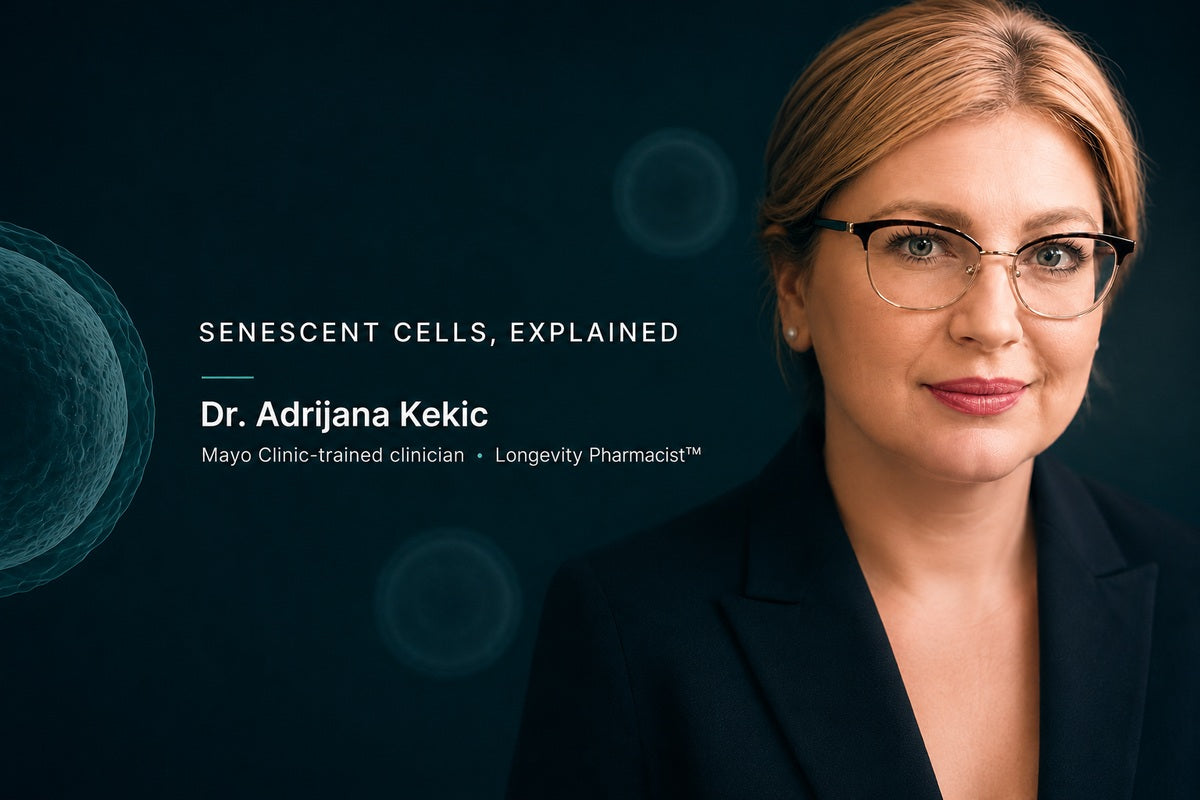
As Dr. Adrijana Kekic, Mayo Clinic-trained clinician, Longevity Pharmacist and Founder of Futurome, explains: "Senescence is not a malfunction. It is a protective mechanism" — a way for the body to halt a cell that has become too damaged to function safely, preventing it from dividing further and potentially causing more harm.
In this sense, senescence is not the enemy. When you are younger, it is part of a well-functioning system.
Why the Immune System Matters
When senescent cells form, the immune system is designed to find them and clear them out. This process works efficiently when we are young — the body produces senescent cells and removes them in a continuous cycle.
But two things change as we get older.
First, more cells become senescent. Decades of accumulated damage — from environmental stress, metabolic wear, inflammation and DNA damage — mean more cells reach a point they cannot recover from.
Second, the immune system ages alongside everything else. Its ability to identify and clear senescent cells declines, precisely at the moment when the demand for clearance is highest.
As Dr. Kekic puts it: "These zombie cells start to build up — and they're not quiet."
What Is SASP - and Why Does It Matter?
Senescent cells do not simply sit dormant. They release a complex cocktail of inflammatory signals known as SASP, or senescence-associated secretory phenotype.
These signals have far-reaching effects. They influence neighbouring healthy cells, which can themselves become senescent in response. They interfere with the body's ability to repair tissue. And they contribute to a state of low-grade, chronic inflammation that researchers increasingly link to accelerated biological ageing.
"This is the case of a bad apple," Dr. Kekic explains, "where one zombie cell can make more."
This spreading effect is one reason why senescent cell accumulation is considered one of the core hallmarks of ageing — not a side effect of it, but a driver.
The Link to Healthspan
Senescence has been associated with a wide range of age-related changes: tissue stiffness, slower recovery, metabolic disruption, cognitive decline and reduced immune function. Researchers are increasingly exploring whether reducing senescent cell burden can influence not just lifespan, but healthspan — the number of years you live in good health.
The evidence so far is compelling. Studies in animal models have shown that clearing senescent cells can improve physical function, delay age-related disease and extend healthy life. Human research is advancing rapidly.
This does not mean ageing can be reversed. But it does suggest that the rate at which we accumulate senescent cells — and our ability to support clearance — is a meaningful target.
What You Can Do
The good news is that senescent cell burden is not fixed. Lifestyle practices including regular movement, targeted nutrition, quality sleep and stress management all play a role in supporting the body's natural clearance mechanisms.
Targeted supplementation is another lever. Certain compounds — including quercetin and fisetin — have been studied for their potential to support the reduction of senescent cell load. This area of research, sometimes called senolytic science, is one of the fastest-growing fields in longevity medicine.
At Cellaro, RESET is our monthly 2-day cellular rejuvenation protocol, formulated specifically with this science in mind. It is designed to support the body's ability to clear senescent cells as part of a structured approach to cellular health.
Why We Are Talking About This Now
Senescent cells are not a new discovery. But the science around them has accelerated significantly, and public understanding has not kept pace.
At Cellaro, we believe that changes when you understand the mechanism. Because once you see clearly what is happening inside your cells as you age, the path forward becomes much clearer too.
This article is part of Cellular Ageing, Explained - a Cellaro video series hosted by Dr. Adrijana Kekic, breaking down the core mechanisms of cellular ageing, episode by episode.