
NMN vs NR — What’s the difference (and why we prefer NMN)
Summary: NMN and NR are vitamin B3 precursors that raise NAD⁺ in humans. We prefer NMN today because it sits one step closer to NAD⁺ in the pathway, recent human trials are accumulating quickly, and it’s easier to keep stable under typical storage.
Who this helps: If you are deciding which precursor to use for steadier daytime energy and recovery, this guide gives you a clear, high-quality path forward.
Last updated: November 2025 • Reading time: ~7 minutes
Why this matters
NAD⁺ levels decline with age. Both NMN and NR can raise circulating NAD⁺ markers in humans, but they are not identical in pathway position, clinical momentum, or real-world stability. Making the right choice up front saves you guesswork.
H2: The pathway, simply
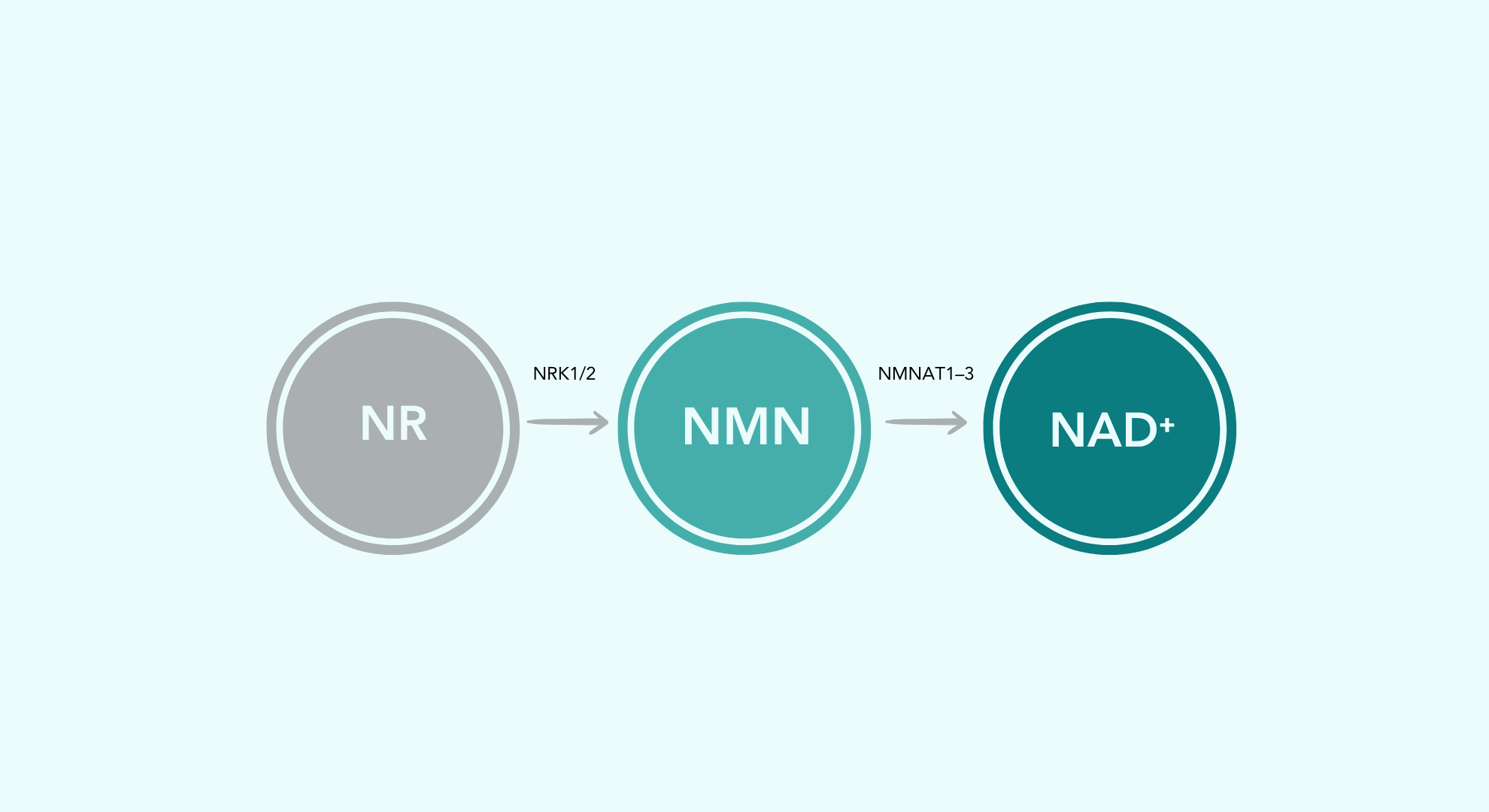
Your body makes most of its NAD⁺ by recycling what it already has. Think of it as a daily reuse loop. In that loop, NR is first turned into NMN, and NMN is then turned into NAD⁺. Because NMN is already the step right before NAD⁺, using NMN means you skip the NR step. Animal studies also suggest the gut can transport NMN efficiently¹; how this maps to humans is still being clarified. The takeaway is simple: both feed the same route, with NMN closer in the sequence.

What human studies say
Human trials for both NR and NMN report increases in circulating NAD⁺ metabolites²⁴⁵. In the last few years, NMN has added randomized trials with functional signals in defined populations, such as insulin-sensitivity measures and walking-distance or quality-of-life readouts²³. Datasets are not identical, but momentum today leans toward NMN.
Stability in real life
NR chloride can degrade to nicotinamide under heat, moisture, and neutral/alkaline conditions⁶⁷. NMN is chemically more robust under typical dry, room-temperature conditions, which makes maintaining label potency simpler through shipping and storage.
Buyer’s checklist
• Evidence and dose that match human studies.
• Identity and purity with a lot-level COA for identity, purity, heavy metals, and microbes, plus screens to rule out excess nicotinamide.
• Stability and packaging with a moisture-barrier bottle or pouch, desiccant, light protection, and a sensible shelf-life rationale.
• Regulatory and transparency with GMP manufacturing, compliant labelling and claims, and real customer support.
• Personal fit using morning dosing, starting low, checking energy, sleep, and GI comfort, and reassessing at eight to twelve weeks, ideally with a repeat NAD⁺ test.
Where VITALIZE fits
Lifestyle is the base. VITALIZE keeps you sufficient when production runs lean. It is an AM routine built on this model: NMN to build, apigenin to help temper age-related NAD⁺ breakdown, and TMG to support methylation so recycling keeps up. It is stimulant-free and designed to complement sleep, movement, and nutrition.
Next steps
Read next: NAD⁺ 101 — The molecule behind cellular energy. Explore: NAD⁺ Blood Test Guide — How to baseline and track your progress. When you want a simple morning plan: VITALIZE — AM NAD⁺ support designed for daily life.
References
-
Grozio A. Nature Metabolism 2019 — Slc12a8 as an NMN transporter (mouse intestine). PubMed
-
Yoshino M. Science 2021 — NMN improved muscle insulin sensitivity/signaling (RCT). Science
-
Yi L. GeroScience 2022 — Multicenter NMN RCT: NAD⁺ markers, 6-minute walk, QoL. PubMed Central
-
Martens CR. Nat Commun 2018 — NR raised NAD⁺ in older adults. Nature
-
Elhassan YS. Cell Reports 2019 — NR increased muscle NAD⁺ metabolome in aged humans. Cell
-
Campbell MTD. Food & Nutrition Research 2019 — NRCl degradation to nicotinamide under certain conditions. PubMed Central
-
Schabert G. Molecules 2021 — NR salt stability across pH/temperature (degradation to NAM noted). PubMed Central
NMN vs NR — What’s the difference (and why we prefer NMN)
NMN and NR both raise NAD⁺. See pathway differences, human



%0A%0ASummary:%20NMN%20and%20NR%20are%20vitamin%20B3%20precursors%20that%20raise%20NAD%E2%81%BA%20in%20humans.%20We%20prefer%20NMN%20today%20because%20it%20sits%20one%20step%20closer%20to%20NAD%E2%81%BA%20...)